


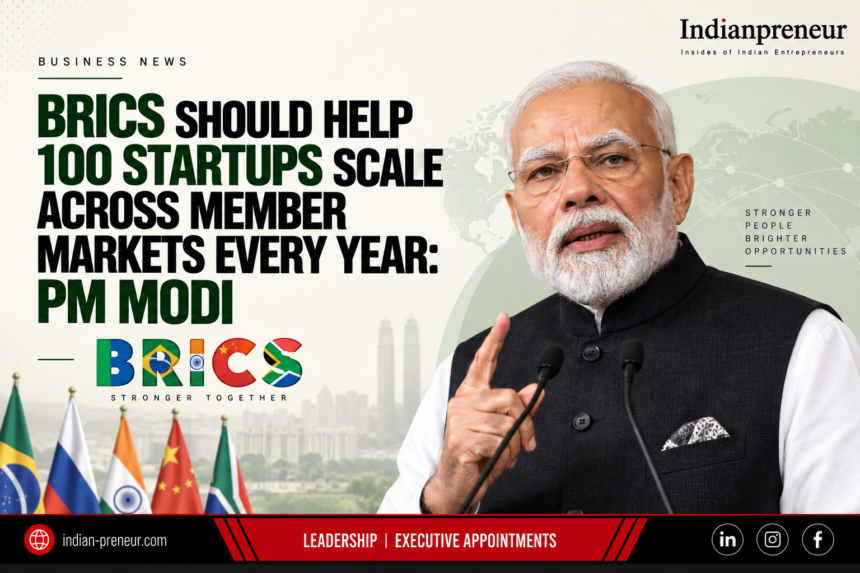
Prime Minister Narendra Modi has called on BRICS countries to strengthen cooperation among startups and businesses, with a target of helping 100 BRICS startups scale into other member markets every year.
Speaking at the BRICS Business Forum 2026 in New Delhi, Modi said the grouping should move beyond discussions and focus on measurable outcomes that can create new opportunities for entrepreneurs and businesses.
PM Modi’s three-point economic agenda
As BRICS enters its third decade, the Prime Minister urged the BRICS Business Council to work on three specific goals:
- 100 startups to expand into other BRICS markets every year
- Identify and work towards removing the top 10 trade barriers among BRICS countries
- Create 1,000 new business partnerships annually
Modi also called for these targets to be reviewed every year to measure actual progress.
| Target | Annual Goal |
|---|---|
| Startups scaling across BRICS markets | 100 |
| New business partnerships | 1,000 |
| Trade barriers to address | Top 10 |
Focus on scaling Indian and BRICS startups
The proposal comes at a time when India’s startup ecosystem has expanded rapidly. During his address, Modi highlighted India’s startup revolution, noting that the country now has more than 2 lakh recognised startups and over 120 unicorns.
The Prime Minister’s proposal could give successful startups a larger customer base beyond their domestic markets. Easier access to other BRICS economies could also help companies attract investment, build partnerships and expand their products internationally.
For startups, entering a new country can often involve challenges related to regulations, finance, market access and business networks. Greater cooperation between BRICS nations could help reduce some of these hurdles.
BRICS initiatives for startups and MSMEs
India has already launched several initiatives aimed at strengthening economic and innovation cooperation within the grouping.
These include the BRICS Incubator Network, BRICS MSME Portal and BRICS Startup Innovation Fund. According to the government, these frameworks are intended to connect startups and small businesses with markets, finance and opportunities across member countries.
The broader objective is to increase the movement of investment, talent, technology and innovation between BRICS economies.
BRICS represents a major global market
The economic opportunity is significant. According to the Prime Minister’s Office, BRICS countries and partners now represent 50% of the world’s population, around 40% of global GDP and more than 25% of global trade.
For entrepreneurs, access to such a large combined market could provide an important pathway for international expansion.
Modi’s message was therefore clear: BRICS cooperation should translate into real business opportunities rather than remain limited to government-level discussions.
A push towards action
The proposed target of helping 100 startups scale across BRICS markets every year is part of India’s broader effort to make the grouping more business-focused.
Along with reducing trade barriers and creating 1,000 new partnerships, the initiative could help strengthen intra-BRICS trade, encourage innovation and create new avenues for entrepreneurs.
Modi summed up the approach by calling for BRICS’ ambition to be converted into action and its collective strength into global solutions.