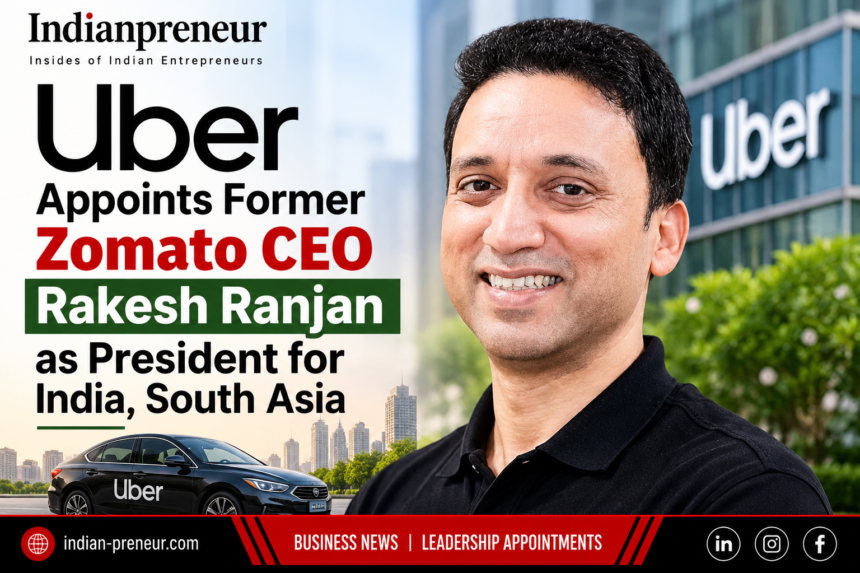
In a major leadership shakeup within India’s booming digital and mobility landscape, Uber has officially announced the appointment of Rakesh Ranjan as the new President for India and South Asia. Ranjan, widely recognized for his transformative leadership as the former CEO of Zomato’s food delivery business, will officially step into his new role on January 4, 2027.
This strategic move signals Uber’s renewed focus on deepening its roots in one of its fastest-growing global markets. Reporting directly to Dom Taylor, Uber’s Regional General Manager for Asia Pacific, Ranjan is tasked with steering the ride-hailing giant through its next phase of expansion, innovation, and driver-partner empowerment across the subcontinent.
Who is Rakesh Ranjan? A Look at His Leadership Journey
Rakesh Ranjan is no stranger to scaling high-growth consumer internet businesses in India. Before accepting the top job at Uber India, he served as the Chief Executive Officer at Allen Online, spearheading the edtech giant’s digital education initiatives. However, his most defining career chapter unfolded over an eight-year stint at Zomato (now Eternal), which he joined back in 2017.
An alumnus of the Indian School of Business (ISB) and a former consultant at the Boston Consulting Group (BCG), Ranjan possesses a rare blend of sharp analytical strategy and on-ground operational grit. During his tenure at Zomato, he wore multiple critical hats before rising to lead its flagship vertical:
-
Scaling Supply & Reach: As Vice President of Food Delivery and Head of Supply, Ranjan played a pivotal role in expanding Zomato’s footprint from just seven cities to over 1,000 cities across India.
-
Driving B2B Growth: Prior to leading the consumer food delivery arm, he served as the CEO of Hyperpure, Zomato’s B2B farm-to-fork supplies business, scaling its operations nationwide.
-
Sales & Subscription Mastery: He also held key leadership positions as Chief Sales Officer for food delivery and led strategic growth for Zomato Gold.
-
Edtech Transformation: Most recently at Allen Online, he focused on building scalable, tech-first learning solutions for millions of students.
Why Uber Bet Big on a Food Delivery Veteran
At first glance, moving from food delivery to ride-hailing might seem like a shift in industries. However, in the Indian tech ecosystem, the operational DNA of both sectors is remarkably similar. Both rely heavily on hyperlocal logistics, real-time supply-demand matching, thin unit economics, and managing massive fleets of gig workers.
Uber’s decision to bring in Rakesh Ranjan after an extensive three-month global search highlights the company’s desire for a leader who deeply understands the nuances of Indian consumers and gig-economy partners. Dom Taylor noted that Ranjan joins a business with real scale and enduring strength, bringing invaluable experience to lead the next chapter of growth in the region.
For Uber, India is not just another market; it is a critical pillar of its global operations:
-
Global Scale: India stands as Uber’s third-largest market globally by trip volume, trailing only behind the United States and Brazil.
-
Massive Driver Network: It is Uber’s second-largest market worldwide in terms of active earners, supporting over two million monthly active drivers across more than 200 Indian cities.
-
Tech Innovation Hub: Beyond rides, India houses Uber’s largest technology and engineering centers outside the US, located in Bengaluru and Hyderabad.
Key Priorities Ahead for Uber India and South Asia
Stepping into the corner office in January 2027, Ranjan faces an exciting yet fiercely competitive landscape. While Uber enjoys strong brand recall, it faces intense local competition from players like Ola, Rapido, and government-backed open networks like Namma Yatri. Furthermore, navigating India’s evolving regulatory framework for gig workers and electric vehicle (EV) mandates will require deft leadership.
Following his appointment, Ranjan emphasized that the opportunity ahead starts with the everyday experience. His immediate roadmap for Uber India and South Asia is expected to center around three core pillars:
-
Dependable Everyday Rides: Improving ride reliability, reducing cancellation rates, and enhancing overall safety and comfort for daily commuters across metros and Tier-2 cities.
-
Better Earning Opportunities for Drivers: Strengthening the driver-partner ecosystem by introducing sustainable earning models, better incentives, and welfare initiatives to retain fleet supply.
-
Value Across Diverse Journeys: Expanding affordable, multi-modal transit options—ranging from Uber Auto and Uber Moto to intercity rentals and green EV fleets—tailored to price-sensitive South Asian consumers.
What This Means for India’s Mobility Ecosystem
The appointment of Rakesh Ranjan as President of Uber India and South Asia marks an intriguing convergence of India’s consumer tech talent. Having navigated hyper-competitive unit economics and massive gig-worker networks during his time at Zomato, Ranjan brings battle-tested experience to the mobility sector.
As Uber looks to unlock its next hundred million users across India, Bangladesh, and Sri Lanka, all eyes will be on how Ranjan leverages his hyperlocal playbook to make daily commuting smoother for riders and more rewarding for drivers.