
The healthcare in India is experiencing an unannounced revolution. Tuberculosis (TB) has over the decades stuck like a thorn on the side of public health in the country. Nonetheless, the story is taking a different turn. The Indian government no longer manages the disease, it is in a race to eradicate it by 2025 five years earlier than the global Sustainable Development Goals.
With the help of AI-powered TB screening and faster nutrition aid, the goal of turning India TB-free is shifting off the distant dream to a reality.
The Digital Shift: AI-Powered TB Screening
The conventional way of TB diagnosis would also take quite long hours, manual testing of sputum, and travel to overcrowded diagnostics units. In rural India, where doctor to patient ratio is skewed, a good number of cases were not detected at an opportune time.
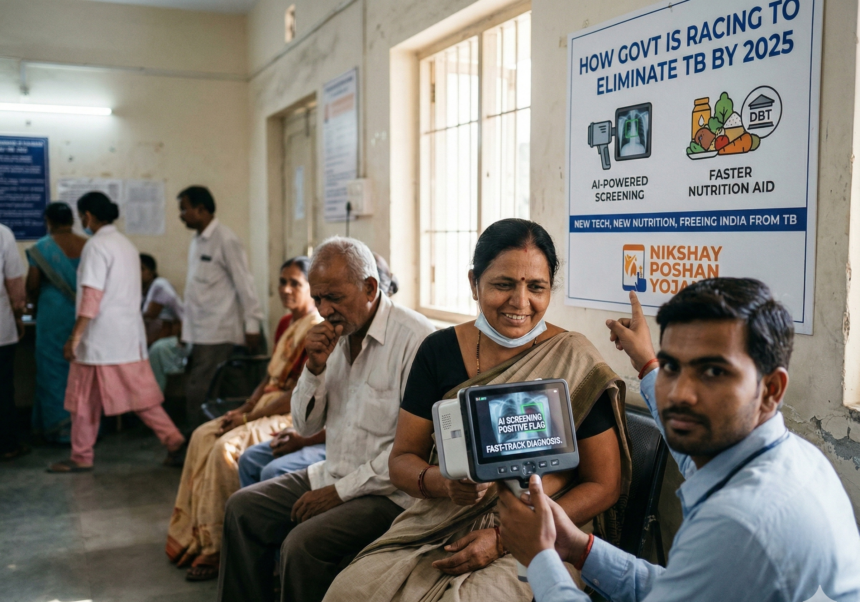
Nowadays, AI-powered TB screening is transforming the game. The government is also rolling out handheld X-ray machines with artificial intelligence to identify lung abnormalities within seconds with the help of advanced algorithms.
How Artificial Intelligence is Faster Diagnosing:
-
Real-time findings: AI Software can interpret chest X-rays instantly, and it will identify possible TB cases without the presence of a radiologist.
-
Mass Screening: AI-powered TB screening mobile vans that have AI-powered technologies are visiting remote villages and screening hundreds of people within a day.
-
Accuracy: The tools will be effective in reducing the human error and even the silent or asymptomatic cases will be detected early.
Nutrition as Medicine: Faster Nutrition Aid
Without medicine, TB cannot be healed in the presence of a malnourished patient. TB is a disease that creates havoc when the immunity is weak. The government has realized this, and hence, it has given increased emphasis on administering faster nutrition aid in the form of Nikshay Poshan Yojana.
Through this program, the TB patients are given direct benefit transfers (DBT) to their bank accounts to cover the nutritional expenses. There is, however, the race of making this process more efficient.
Noted: Important Nutrition Support Improvements:
-
Direct Benefit Transfer (DBT): By removing the middlemen, the faster nutrition aid is delivered faster directly to the account of the patient once he or she is diagnosed.
-
Increased Allowances: More current policy changes have been made to the monthly support amount taking into consideration the increased costs of a high-protein diet.
-
Community Support: The Ni-kshay Mitra program enables the communities and organizations to adopt the TB patients and offer them extra food baskets and vocational assistance.
The Roadmap to 2025: A Multi-Pronged Strategy
The eradication of any disease in such a huge population of 1.4 billion cannot be done solely by use of technology but a grand logistical overhaul is needed. Four pillars are formed in the government strategy; Detect, Treat, Prevent, and Build.
| Strategy Pillar | Action Taken | Technology Aid Role |
| Detect | Door to door monitoring | AI-powered TB screening |
| Treat | Fixed-dose combinations (FDC) | Electronic monitoring of pill taking |
| Prevent | Latent TB infection treatment | Faster nutrition aid to enhance immunity |
| Construct | Infrastructure support of lab networks | Health portals |
Why Speed Matters
Whenever it comes to infectious diseases, time is of the essence. One infected TB patient who has not been diagnosed may infect 10 or 15 individuals annually. That is why AI-powered TB screening is not an option; this is a necessity. The chain of transmission is interrupted by making the interval between coughing and administration of medicine as short as possible.
At the same time, faster nutrition aid will guarantee that the patients will follow the treatment. A crucial challenge to TB eradication is the so-called Loss to Follow-up or situations when the patient discontinues medication due to their feeling of weakness or the lack of financial resources. The government should provide faster nutrition aid because it can greatly increase the adherence rates of treatment.
Challenges on the Horizon
Although the combination of AI-powered TB screening and faster nutrition aid are a promising path forward, it is not going to be a smooth ride.
-
Digital Literacy: Educating frontline health workers (ASHAs) to make effective use of AI tools is still an agenda.
-
Last-Mile Connectivity: Advocating faster nutrition aid to patients in areas with the low banking framework.
-
Social Stigma: TB despite all the technological innovations, people are often afraid of the stigma related to it; thus, they rarely seek an AI-powered TB screening.
The Power of Public-Private Partnerships
The government is not the only participant in the race of eliminating TB. India is now integrating the private healthcare providers who treat almost half of the TB patients in the country. This is because by requiring TB notification and availing AI-powered TB screening protocols to private labs, the government is making sure that no patient is left behind.
Also, the participation of corporate India in financing the faster nutrition aid with CSR activities has also given the additional impetus to implement such programs on the national level.
Conclusion: A Healthier India
The amalgamation of technology and compassion is what can characterize the present healthcare mission of India. The government is establishing a sturdy safety net by placing AI-powered TB screening into the hands of the rural health workers as well as guaranteeing faster nutrition aid deposits in the bank accounts of the vulnerable.
We are also experiencing a change in the reactive healthcare system to a proactive one. Provided that the current trend is maintained, the objective of a TB Mukt Bharat (TB-Free India) will not only be a motto, but also the milestone in the history of global health. The competition has begun and, now, we have the tools, the determination to win, like never before.