
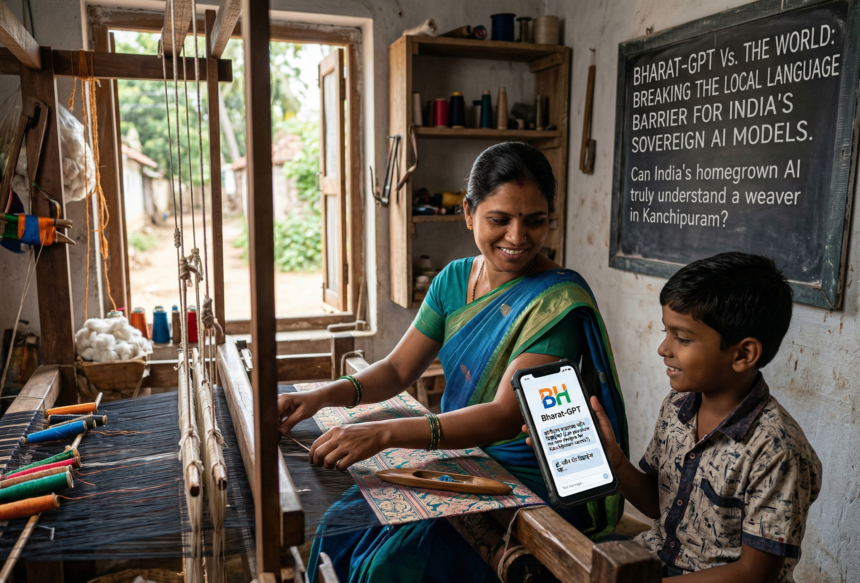
The digital discourse in the silicon valleys of the West has been determining the conversation over decades. Now we find ourselves entering the age of Generative AI and the question no longer resounds within the streets of Delhi and Bengaluru, but rather within their banks, Can a model that has been trained on the banks of the Potomac really know a farmer in Pune or a weaver in Kanchipuram? Here is where Bharat-GPT comes into the scene, and it is the bold step of India towards Sovereign AI Models.
The tech supremacy is not as high a stake. The Local Language Barrier is not a hump to jump in a country where there are 22 official languages with thousands of dialects, but rather a wall. Notwithstanding global leaders such as OpenAI and Google who take center stage, India is placing its bet on the so-called Sovereign AI Models solutions to close the digital divide.
Why Global AI Often Fails the “Indian Test”
The majority of the world LLMs are trained on a Western diet. They use English as their first language, and the logic of their cultures is based on Western scenarios. When such models attempt to talk in Hindi, Bengali or Marathi they end up stuttering.
-
Translation vs. Transliteration: Unlike in the US, in the global models, translation is done word to word without extracting the essence of the sentence.
-
Cultural Sensitivity: An AI must understand that there is a distinction between Namaste and Ram Ram in order to really fit in the heartland.
-
Tokenization Problems: All world models are ineffective in handling Indic scripts and hence slower to execute in local languages.
It is this gap that Bharat-GPT and other Sovereign AI Models are supposed to close. It is not that they are merely seeking to compete but seek to communicate.
The Rise of Sovereign AI Models in India
The Indian attitude towards AI is different. We are not only creating chat bots, we are creating infrastructure. The concentrated attention of the Indian government and the players, such as CoRover and Krutrim, on Sovereign AI Models guarantees that Indian data remains in India and benefits the Indians.
Some of the Major Contenders in the Race:
-
Bharat-GPT: A product of CoRover.ai in collaboration with Bhashini, it is intended to offer a massive multi-modal experience in dozens of Indian languages.
-
Krutrim: The ambitious project of Ola that was aimed at learning Indian consumer pulse.
-
Hanooman: A collective of Indic LLMs Patronized by Reliance and high-end academic organizations.
These models are designed in such a way that they break the Local Language Barrier. They are educated on native data sets and hence they are equipped with the syntactic, lingo, and mood of the ground.
How Bharat-GPT Tackles the Local Language Barrier
Inclusivity is the main mission of Bharat-GPT. English does not have to be the admission cost of the internet to a rural businessman or a student at the Tier-3 city.
-
Multi-modal Capabilities: It does not read text only but comprehends voice and video and this is important because the country has different literacy levels.
-
Bhashini Integration: Bharat-GPT can access high-quality Indian curated datasets on the Bhashini platform of the government.
-
Real-time Accuracy: It should be GST questions or agricultural advice, any way, these Sovereign AI Models have been trained to be useful to the region and not conversation in general.
The “Sovereign” Advantage: Data and Security
What is the point of having Sovereign AI Models? Why not simply take advantage of what is available? The solution is in Data Sovereignty.
With the help of foreign models, we handle our patterns of linguistics, culture preferences, and sensitive information on other servers. With the construction of Bharat-GPT, India will make sure that its digital development is self-sufficient.
Moreover, a Sovereign AI can be tailored to the governance and healthcare and education systems of India in a manner that the generic global model could not.
Challenges on the Horizon
Bharat-GPT will not sail smoothly as the way even has its thorns despite the optimism.
-
Computing Power: The high-end GPUs are costly and difficult to purchase, which leaves India in a disadvantageous position over Big Tech.
-
Scarcity of the Dataset: Although we have a large number of speakers, very little of high-quality, digitized text in languages such as Maithili or Santali is available.
-
The Talent Gap: India is the largest developer base in the world, but in the high demand specialization areas of AI researchers are also scarce worldwide.
Can India Actually Win?
Bharat-GPT vs. the battle. It is not about the parameters that one has; the World is about who offers the most value to the next billion users. Local Language Barrier has placed millions of Indians in the digital darkness too long.
And should Sovereign AI Models be able to give a farmer in Bihar the competence in his native language that a techie in San Francisco would get in English, then not only has India just won a technology race, it has won a social revolution.
Final Thoughts
The Bharat-GPT is a reminder that technology should be democratic as it develops. India is therefore making sure that the future of intelligence is not artificial only, but it is also genuine to our culture by paying attention to Sovereign AI Models. The Local Language Barrier is finally finding its counterpart and the discussion is not over yet.