

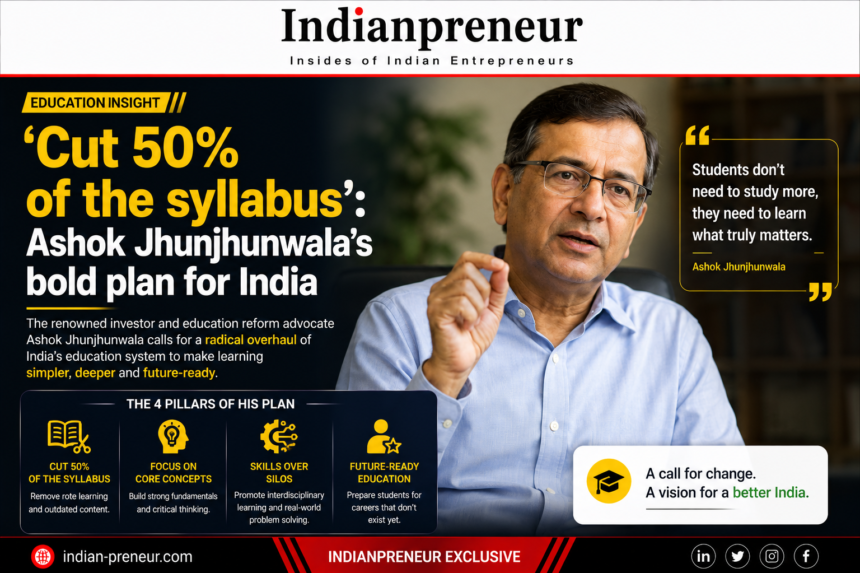
‘Cut 50% of the syllabus’: Ashok Jhunjhunwala’s bold plan for India has sparked a fresh debate on the future of India’s education system. The renowned IIT Madras professor, deep-tech pioneer, and Padma Shri awardee believes that India’s schools and colleges should focus less on rote learning and more on building practical skills, innovation, and entrepreneurship.
Speaking at the launch of his authorised biography, Roots & Wings: Building India’s Deep Tech Ecosystem, Dr. Ashok Jhunjhunwala argued that students are spending too much time memorising information instead of learning how to solve real-world problems and create impactful businesses.
Why Ashok Jhunjhunwala wants the syllabus reduced
According to Dr. Jhunjhunwala, nearly half of the existing school and engineering curriculum can be removed without affecting students’ ability to learn. Instead, educational institutions should encourage students to develop practical knowledge, collaborate on projects, and build innovative solutions.
The idea behind ‘Cut 50% of the syllabus’: Ashok Jhunjhunwala’s bold plan for India is to make learning more meaningful by reducing unnecessary academic burden and allowing students to spend more time experimenting, designing, and creating.
He emphasized that education should prepare students for lifelong learning rather than simply helping them score high marks in examinations.
Focus on creating builders, not exam toppers
One of Dr. Jhunjhunwala’s strongest messages was that educational institutions should produce “builders” instead of students trained only to clear examinations.
He believes India’s future depends on individuals who can identify problems, develop innovative technologies, and build companies capable of solving large-scale national challenges.
The vision behind ‘Cut 50% of the syllabus’: Ashok Jhunjhunwala’s bold plan for India is closely linked with strengthening India’s deep-tech ecosystem and making innovation a central part of education.
Call for more entrepreneurs
Dr. Jhunjhunwala also highlighted the importance of entrepreneurship in India’s economic growth. He suggested that the country should aim to create nearly 20 million entrepreneurs who can generate employment, develop new technologies, and contribute to national development.
According to him, India’s demographic advantage can only be fully utilised if students are encouraged to become job creators rather than only job seekers.
Key recommendations
Some of the major suggestions shared by Dr. Jhunjhunwala include:
● Reduce nearly 50% of existing academic syllabus.
● Shift from rote learning to practical education.
● Encourage innovation from an early stage.
● Promote hands-on engineering and product development.
● Increase focus on entrepreneurship.
● Teach students how to continuously learn new skills.
● Strengthen collaboration between academia and industry.
These recommendations aim to prepare students for rapidly changing technologies and future job markets.
Why the proposal matters
India’s education system has often been criticised for placing excessive emphasis on examinations and theoretical learning. At the same time, industries increasingly demand graduates with practical skills, critical thinking, and problem-solving abilities.
Supporters of ‘Cut 50% of the syllabus’: Ashok Jhunjhunwala’s bold plan for India believe reducing unnecessary academic content could allow institutions to dedicate more time to research, internships, innovation, and startup development.
Many experts also argue that flexible learning models will become increasingly important as artificial intelligence and automation continue transforming industries.
Industry reaction
The proposal has generated discussions among educators, startup founders, policymakers, and technology leaders.
Supporters believe curriculum reforms can help students become more adaptable and industry-ready. Others point out that any syllabus reduction should be carefully planned to ensure that essential academic foundations remain strong.
Education experts also note that curriculum reform should be accompanied by improved teacher training, project-based learning, and stronger industry partnerships.
India’s growing innovation ecosystem
Dr. Jhunjhunwala has played a significant role in promoting innovation and entrepreneurship through IIT Madras and its Research Park, which has supported hundreds of startups over the years.
His latest remarks reinforce the idea that educational institutions should actively nurture entrepreneurs capable of developing globally competitive technologies.
As India continues investing in deep-tech, artificial intelligence, semiconductors, and advanced manufacturing, practical education is expected to become increasingly important.
Conclusion
The proposal ‘Cut 50% of the syllabus’: Ashok Jhunjhunwala’s bold plan for India has opened an important conversation about the future of education in the country. By advocating a leaner curriculum, greater emphasis on practical learning, and stronger entrepreneurial thinking, Dr. Ashok Jhunjhunwala believes India can prepare students to become innovators rather than simply examination candidates.
Whether these ideas eventually influence education policy remains to be seen, but they have certainly reignited the debate on how India can build a future-ready workforce capable of driving technological and economic growth.