

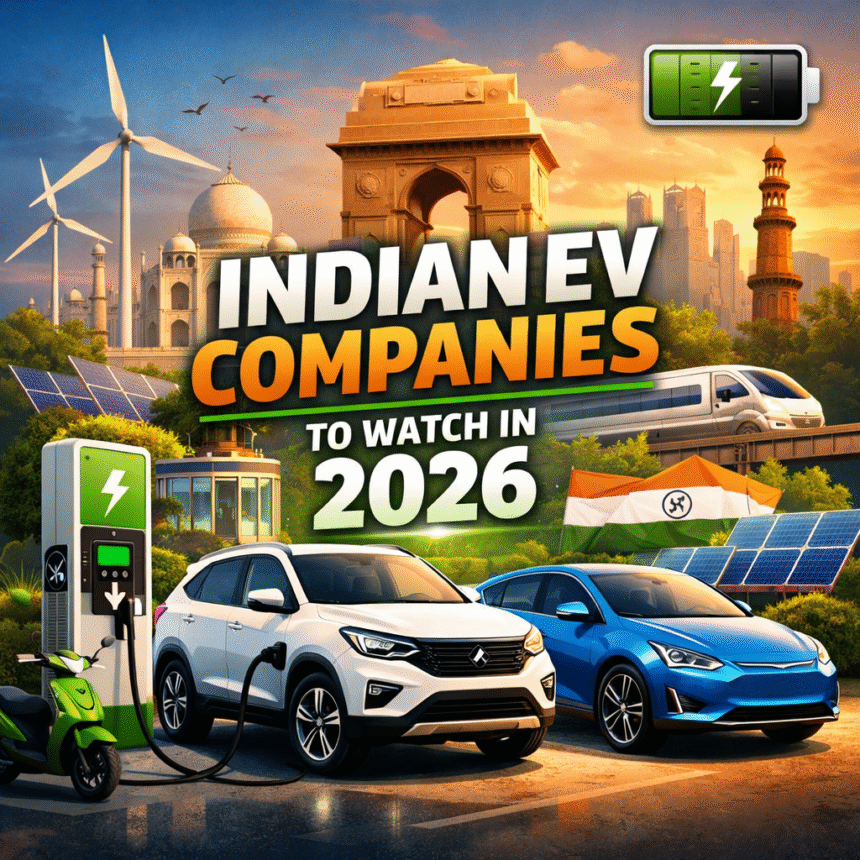
Industry-by-industry perspective of the companies that will assist India in becoming the world of electric mobility, which entails vehicle production, battery technology, charging network, and intelligent mobility solutions.
The transition of Indian EV is growing. New ventures and up-and-coming manufacturers are past pilot projects. They are currently developing commercial vehicles, battery foundations, and countrywide charging infrastructures in main mobility hubs.
The most significant shift towards 2026 is obvious. The EV transition in India is shifting to the market forces rather than the government. Winners will be based on affordability, infrastructure, and technology.
The list of Indian EV companies to follow in 2026 is provided below. These are listed on the basis of innovation, potential to scale and impact in the sector.
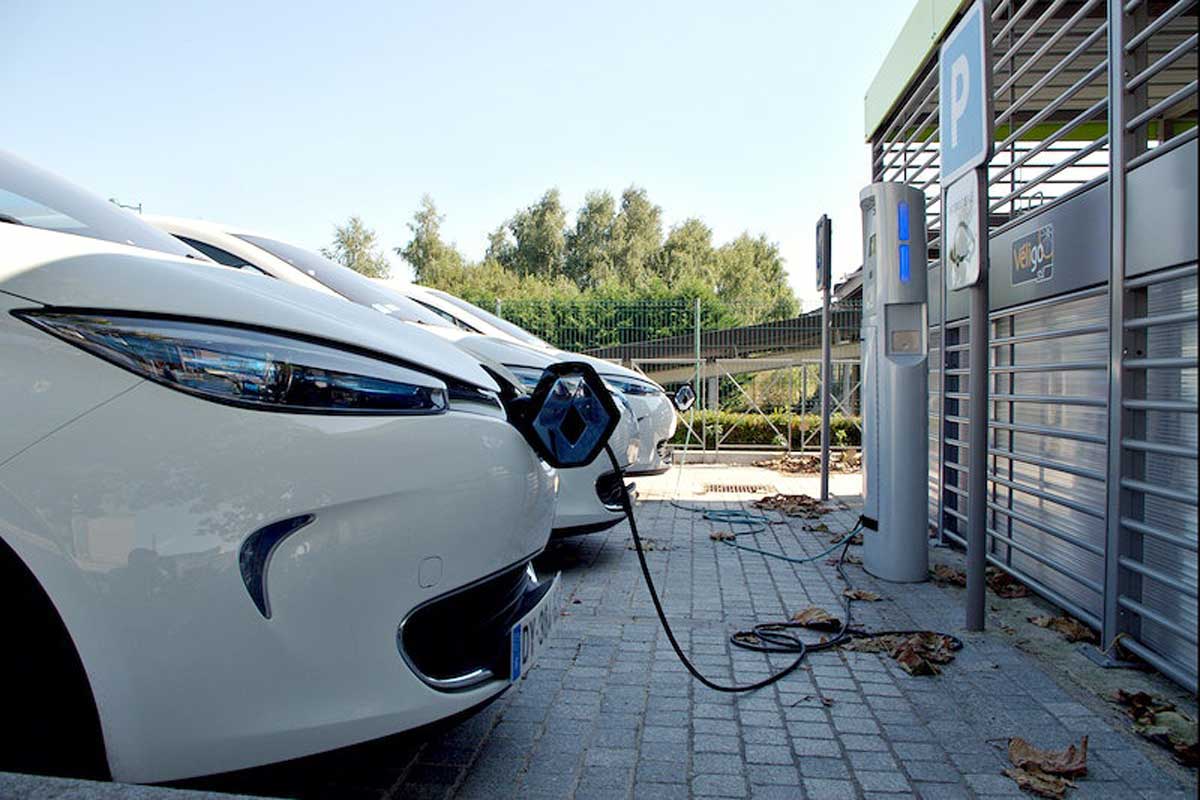
Electric Vehicle Manufacturing
Ola Electric
Founder / CEO: Bhavish Aggarwal
- Headquarters: Bengaluru
- Founded: 2017
- Target: Scooters and mass production of EVs.
Why it is important: Large-scale production and integration of ecosystems.
Ola is developing a large EV production ecosystem in India. It entails car manufacturing, battery design and integration. It is a major force towards the mass EV adoption due to its scale ambitions.
Ather Energy
Co-Founders / CEOs: Tarun Mehta, Swapnil Jain
- Headquarters: Bengaluru
- Founded: 2013
- Target: Luxury e-scooters and smart mobility.
Why it is important: User experience based on technology.
Ather is an integration of performance engineering, interconnected software and the rapid-charging system into the scooter platform. The change towards quality mobility of electric urban mobility can be seen in its strategy.
Tata Passenger Electric Mobility within Tata Motors.
Key Leadership: Shailesh Chandra (Managing Director, Tata Motors Passenger Vehicles & Tata Passenger Electric Mobility)
- Headquarters: Mumbai
- Founded: 2021 (EV division)
- Target: Premium and mass market electric cars.
Why it is important: Indian EV cars market leadership.
With the robust manufacture foundation held on Tata, the EV arm promotes the popular application of electric cars by the low cost, localization, and charging facilities. It has stayed in the heart of the four-wheel EV development scheme in India.
Mahindra Electric
Key Leadership: Rajesh Jejurikar (Executive Director & CEO, Auto and Farm Sector, Mahindra Group)
- Headquarters: Bengaluru
- Founded: 2010
- Specialization: Commercial EV forums and commercial electric car production.
Why it is important: The move into utility EVs in high volumes.
Mahindra Electric is fast tracking next-generation electric SUVs and fleet vehicles, which should be aimed at consumers and businesses. This leaves it in good positions to make mass demand on electrification.
Simple Energy
Founder / CEO: Suhas Rajkumar
- Headquarters: Bengaluru
- Founded: 2019
- Target: The target of the company is long-range electric scooters.
Why it is important: Two-wheelers performance and range innovation.
Simple Energy is here to concentrate on long battery range and high efficiency, the largest impediment to EVs adoption, range anxiety.
Battery and Energy Innovation
Exide Energy Solutions
Key Leadership: Subir Chakraborty (CEO, Exide Energy Solutions)
- Headquarters: Kolkata
- Founded: 2022 (EV battery division)
- Target market: Lithium-ion batteries.
Why it is important: Battery chain development of domestic battery.
The EV business that Exide is pursuing encourages the manufacturing of local batteries that will avoid international sourcing of cells and enhance the energy security in India.
Ola Cell Technologies
Founder / CEO: Bhavish Aggarwal
- Headquarters: Bengaluru
- Founded: 2022
- Communication: Auto EV battery cell production.
Why it is important: Vertical EV energy system integration.
The battery project by Ola should focus on end to end cell to vehicle EV control. This is one of the sources of cost reduction and scale.
Log9 Materials
Co-Founders: Akshay Singhal, Kartik Hajela, Pankaj Sharma
- Headquarters: Bengaluru
- Founded: 2015
- Specialty: Battery technology that is fast-charging.
Why it is important: Saved time in commercial EVs charging.
Log9 invents rapid-charge battery technology applicable to fleet and logistics vehicles, in which the downtime translates directly to revenue.
Charging Infrastructure and Mobility Tech
Statiq
Co-Founders: Akshit Bansal, Raghav Arora
- Headquarters: Gurugram
- Founded: 2019
- Specialization: EV charging software and network.
Why it is important: Increase in the availability of public charging.
Statiq is developing massive charging networks in cities of India to overcome one of the greatest points of bottleneck in EV adoption.
ChargeZone
Founder / CEO: Kartikey Hariyani
- Headquarters: Vadodara
- Founded: 2018
- Expertise: Highway fast-charging networks.
Why it is important: It will facilitate the long-range EV.
ChargeZone targets intercity fast-charging corridors, one of the necessities of the nationwide applicability of EVs.
Kazami Energy
Founder / CEO: Akshay Shekhar
- Headquarters: Delhi
- Founded: 2020
- Specialization: Infrastructure batteries replacement.
Why it is important: Commercial fleets are turning around faster.
Battery swapping minimizes waiting time when it comes to charging, which presents EVs as more practical to use in delivery and ride-hailing businesses.
The Road Ahead
The future of EV in India in 2026 will be defined by the magnitude of its production, battery autonomy and access to charging instead of just experimentation.
The winning companies will provide cheaper cars, energy infrastructure, and infrastructure all over the country.
With converging policy support, consumer demand, and technology maturity, India is increasingly being closer to turning out to be an electric mobility innovation center in the world.