

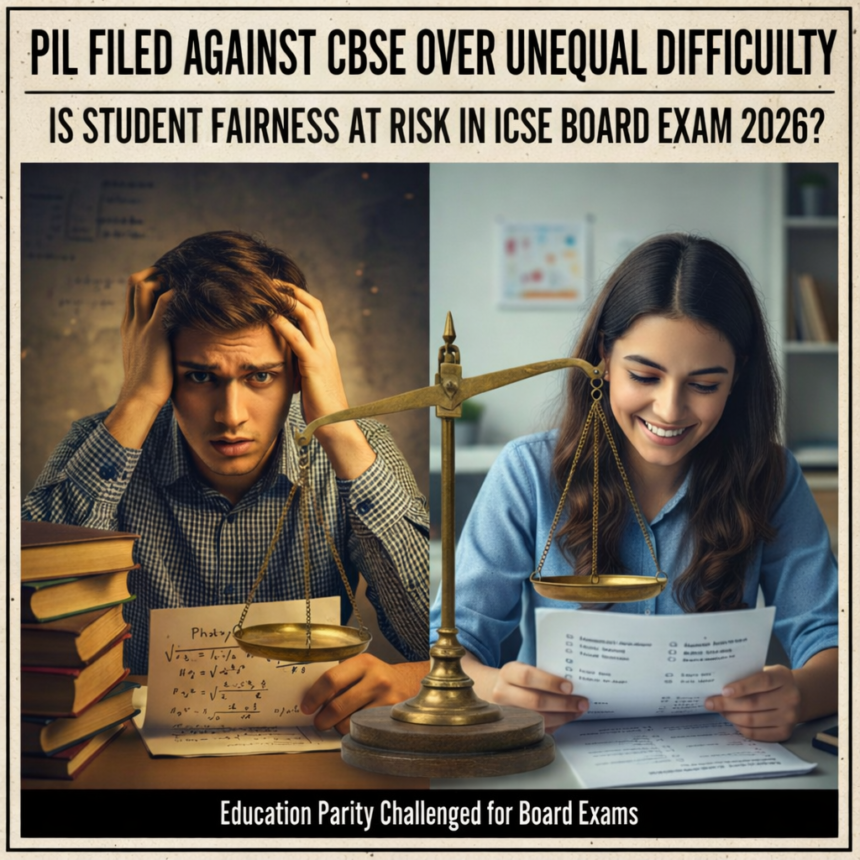
The CBSE Board Exam 2026 is the recent exam that has been in the limelight of the storm. These examinations are the most crucial phase in the academic life of millions of students in India. Nonetheless, the current CBSE Board Exam 2026 session hit a contentious chord after the complaints of a high distributive disparity in the difficulty of various question paper mode.
This was further intensified when there were reports of a PIL Filed Against CBSE Over Unequal Difficulty in different sets, particularly in the CBSE Class 10 Mathematics and CBSE Class 12 Physics papers. It has caused a tremendous controversy among students, parents and the educators concerning the equity of the existing testing system.
Understanding the Controversy: The Inequitable Distribution of Difficulty Levels
As is customary with the CBSE Board Exam 2026, the board equated to providing several sets of question papers as a way of security measures and a preventive measure against cheating. Nevertheless, following the end of the CBSE Class 10 Mathematics and CBSE Class 12 Physics tests, a news of disappointment erupted in the social media and learning platforms.
There were also claims made by students who got specific sets (Some areas had Set 3) of paper that their paper was a lot tougher when compared to other sets. The major complaints were:
-
Competitive Level Questions: There were reports of Competitive Level Multiple Choice Questions (MCQs) that reflected the concept of the JEE Main or even JEE Advanced, instead of taking the standard NCERT pattern.
-
Time Management Problems: Although there were those that were direct and derivation-based, some of those were calculation-based and it was almost impossible to complete them in time.
-
Allegations Out-of-Syllabus: Numerous students and teachers indicated that certain questions were apparently not part of the given CBSE curriculum or based on the ideas not described in the NCERT textbooks.
The Legal Battle: Why a PIL was Filed Against CBSE
The increasing anger made one leading online educator and Exphub founder Prashant Kirad declare the filing of a Public Interest Litigation (PIL). The PIL Filed Against CBSE Over Unequal Difficulty is that of thousands of students, all of whom have been asked to voice their grievances with the court because they feel that the favor of fate has befallen them by the heels.
The PIL Filed Against CBSE is based on the principle of the Right to Equality constituted in the Indian Constitution. This is because, according to the petition the students need to be placed on the same playing field when they all have an interest in the same college seats and scholarships. When one of the students receives a very easy paper and other gets a paper of JEE level then the final percentage rate cannot be treated as a good indicator of their relative merit.
Key Demands in the PIL:
-
Grace Marks– tough sets: The petition request is a directive as to CBSE to give grace marks to students who were randomly put on the more challenging sets as well.
-
Lenient Evaluation: It has been requested that the board direct examiners to use a lenient policy in checking the affected sets of papers.
-
Equality of Difficulty level: The PIL calls on the board to institute a stronger system where variability between sets continues to be nonexistent in exams yet to come.
Inside the CBSE Question Paper Setting and Moderation Process
In order to get the “What We Know” bit of this controversy, it is important to examine the current mode of running the paper-setting process that is undertaken by CBSE. In the past CBSE has insisted that its CBSE Moderation Policy is formulated to deal with these very issues.
| Description | First standard preparation/procedure facilitating entry of students |
| Paper Sets | Several sets (typically 3 primary sets) are prepared to avoid focal cheating. |
| Moderation Policy | A statistical procedure to make the marks consistent in case a group has been statistically adjusted to be found to be statistically more difficult. |
| Expert Committee | A group of subject experts gets to go through the papers with the aim of ensuring that they comply with the NCERT syllabus. |
| Difficulty Distribution | Question papers are to be composed in such a way that there are 20 percent easy questions, 60 percent moderate and 20 percent tough questions. |
These measures have not resolved the scene, with the CBSE Board Exam 2026 being perceived as having no gap between this distribution, leaving students feeling cheated on, especially those who chose to take Mathematics Basic with the expectation of finding it easier than Mathematics Standard.

The Human Cost: How Unequal Difficulty Affects Student Futures
The saddest part of the lawsuit filed against CBSE Over Unequal Difficulty is the mental stress upon students. In the Indian education, a 1 percent variation in CBSE Board Exam may be either the criteria that a student proceeds to enroll at a top notch university or not.
The situation can be referred to as that of a student who is studying 14 hours a day and receiving set of questions of JEE level physics, whereas a colleague received a direct and textbook-based paper. Is it knowledge test or luck test? The hacking virus that removed the code was discovered in the code itself, attached at the very base of the pilgrimage along with the final letter of the script, ph.
The Petition Complaint PIL Filed Against CBSE brings to the fore the fact that a number of students are now insisting on the re-examination or at least a formal explanation on how the board is planning to normalize the scores.
Official Stance and Future Expectations
This is because, to date, Central Board of Secondary Education (CBSE) has not issued a statement specifically with respect to PIL. The board has, however, recently provided a notice to the schools which includes encouraging them to report any question paper observations or discrepancies via the official OECMS portal within the same day as the exam.
Its board usually considers its CBSE Moderation Policy as a way of filling the difference between difficult and easy collections in the result preparation stage. Nevertheless, the teacher making the PIL provides that this out secret regulation is not transparent and fails to take into consideration the trauma and panic that students undergo when passing through the three hours of a surprisingly difficult exam.
What happens next?
-
Court Hearing: The judiciary will consider in all probability whether the CBSE acted in embracing its own bylaws when it came to setting of papers.
-
Internal Review: CBSE can establish an internal team of experts who can analyze the set of contested questions of Class 10 Mathematics and Class 12 Physics by analyzing their difficulty index.
-
Result Normalization: In case the court believes in the merit in the PIL Filed Against CBSE, then the board may be forced to give the normalization formula or certain grace marks.
Conclusion: A Urgent Demand for Transparency and Fairness
The PIL Filed Against CBSE Over Unequal Difficulty is a wake up call to the biggest secondary education board in the country. Although the motive of the multiple sets is security, equity should not be sacrificed. You may be a student who is adopting the CBSE Board Exam 2026 or it may be a desperate parent, the requirement is plain simple Uniformity, Fairness, and Transparency.
Until the legal action will begin and the board will officially take a stand, we suggest students should not forget their remaining exams. The results of this PIL would possibly change the pattern in the future regarding the organization of such national-level examinations as it would make sure that finally, the issue of luck would not be a part of the academic success equation.