


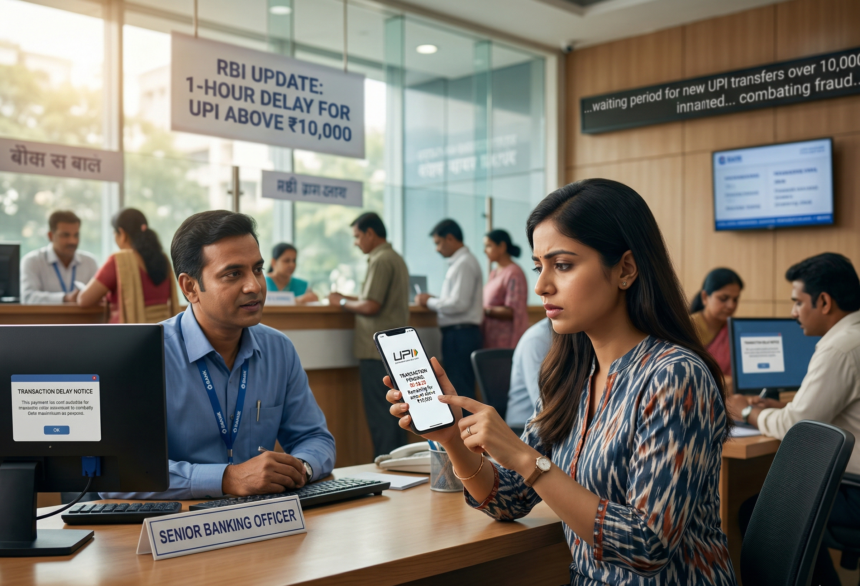
India is on the verge of a major transformation in the digital payment security landscape. Speed and convenience have been a priority in the Reserve Bank of India (RBI) and the National Payments Corporation of India (NPCI) over the years, and UPI payments are the mainstay of our everyday economy. But, with the highest rates of digital adoption ever, it increases the creativity of cybercriminals.
In a move to curb the increasing number of online fraud prevention, the RBI is also contemplating a third line of offense: imposing a 60-minute lag on some high-value transactions. This move would alter the perception we have on instant transfers, should this be implemented.
Why is the RBI Considering a 4-Hour Delay?
Security is the major driving force behind this possible RBI policy. Presently, UPI payments are immediate. This is very nice when it comes to purchasing groceries but it also allows loopholes to phishing and social engineering scams. After being duped to transfer money, the money is lost within seconds through a network of mules accounts and it is almost impossible to retrieve the money once lost by the bank or the law enforcer.
The RBI will create a buffering period by imposing a waiting period for UPI to have a cooling-off period. The users have the opportunity to:
-
Check the Recipient: Confirm that they actually was to send a big amount.
-
Report Fraud: Call their bank to freeze the transaction in case they understand that they have been defrauded.
-
Stop the Scammer: Disrupt the sense of urgency that the fraudsters usually apply to control their victims.
The Details: Who Will Be Affected?
It should be mentioned that it will not impact your morning chai or little shopping expenses. Under certain conditions, the proposed UPI transaction limit in this delay is likely to go off:
-
Value Threshold: The delay will probably be based on UPI payments above Rs 10,000.
-
First-Time Transactions: This is concerned with transfers between a pair of users who have never transacted previously.
-
Digital payment security: This falls under a larger initiative of enhancing digital payment security on all platforms and not just certain apps.
How Will the 1-Hour Window Work?
Industry sources claim that the plan is not to block the payment but to slow it down. As you make a UPI money transfer to a new recipient beyond the limit, the money would not arrive to the recipient account instantly. Rather, the system will wait 60 minutes before commencing the transaction.
In this time frame, both the sender and the receiver may be notified. This brings an element of online fraud prevention on the internet which has been lacking in the real-time ecosystem.
Balancing Convenience and Safety
India has also become a worldwide leader in the real-time payments and any attempt to slow the process is subject to debate. The following is an overview of advantages and disadvantages of this suggested new UPI rules:
| Feature | Impact |
| Security | High. Considerable decrease in instant fraud losses. |
| User Experience | Medium. Could be annoying to high-value urgent, genuine purchases. |
| Fraud Prevention | High. Provides banks with time to execute fraud prevention algorithms. |
| Adoption | Low. Could drive some of the users to cash in case of emergency large payments. |
The Rising Need for Online Fraud Prevention
Increased UPI scams has turned out to be a nightmare to the RBI. Fraudsters keep on changing with fake QR codes to a screen sharing scam. Basic security systems such as UPI PINs are easily overcome by use of psychological manipulations.
Waiting period for UPI is a barrier to the digital world. It is in line with the idea of the RBI to ensure that the Indian financial ecosystem is secure by design and not by chance as fast by design.
What Should Users Expect Next?
Although the RBI has not yet issued any formal circular, the consultations with the NPCI and other stakeholder banks are well underway. In case all the pilot projects demonstrate that the number of digital payment fraud related to digital payments decreases, we may anticipate the introduction of these new UPI rules at the national level in the nearest future.
In the meantime, users ought to maintain safe online habits:
-
Do not give out your UPI PIN to the phone and on unchecked links.
-
Keep in mind that there is never a PIN to be entered to get money.
-
Check the name of a recipient on the screen and press the button Send.
The move to the waiting period for UPI may seem as retrogressive in regard to speed, yet in the long run, it is a required jump to digital payment security in India. A 60-minute wait is nothing to ensure that our well-earned money is safe.