

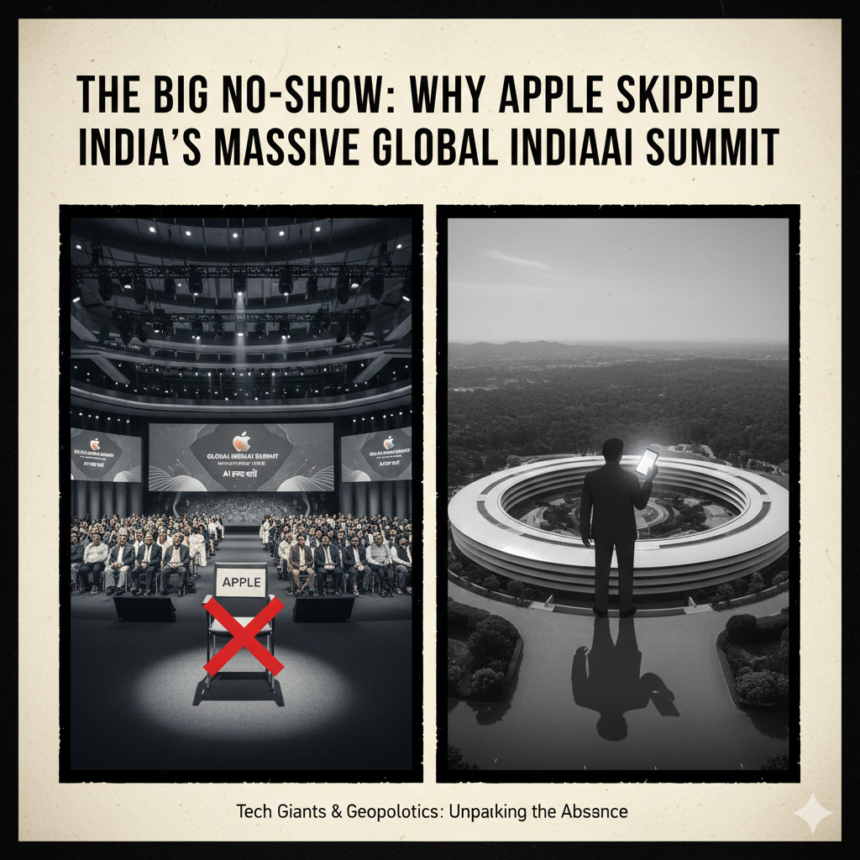
The recent Global IndiaAI Summit at Bharat Mandapam, New Delhi, was unquestionably a tech show. Having such heavy hitters as Sundar Pichai, Sam Altman, and even Bill Gates on the list initially, the event was aimed to demonstrate that India turned out to be the next big infrastructure capital in terms of the Artificial Intelligence world. Nevertheless, another legendary symbol was still missing when the cameras strobed and the dots were put on the paper—the bitten apple.
Even as other competitors such as Google and Microsoft were committing their billions to Indian data-centres, Apple opted out. This left many people with a very important question to answer: why was the world-valued technology company not present in the largest AI platform in India?
A Different Strategy: Why Apple Prefers Distribution Over Infrastructure
This is the key reason why Apple does not attend the Global IndiaAI Summit because of its own original business DNA. Apple does not deal the same with other competitors like OpenAI or Google who are competing on high stakes to create the largest foundational models and extensive GPU clusters.
-
The Gatekeeper Strategy: Apple does not wish to be the brains to all; it would like to be the face whereby you can reach it.
-
User Experience First: They concentrate on Apple Intelligence, a set of functionalities that reside on your iPhone and Mac.
-
Partnership Power: Conditioning itself on the integration with ChatGPT and potentially the new Google called Gemini, Apple allows other players to do the burdensome work of model training, but they manage the user interface.
In a nutshell, whereas the IndiaAI Summit is aimed at the creation of the backend—the servers, the cooling, and the code—Apple is concerned with the front end only.

The Cupertino Wall: How Data Privacy Kept Apple Away from the Summit
The other significant reason is the strict attitude of Apple on data privacy. Lots of debates at the Global IndiaAI Summit were based on the so-called sovereign AI and dataset sharing to train local models. On-device processing, the Private Cloud Compute feature of which Apple boasts, does not make it a frequent contender on the open-forum policy discussions where sharing data is the staple. To them, attending a summit that advocates the idea of data democratization may be out of place with their closed-ecosystem philosophy.
Beyond the Summit: Apple’s Rapidly Growing Footprint in India
Does the lack of this imply that Apple is not paying attention to India? Far from it. Actually, the presence of Apple in the country is expanding at a rapid rate.
| Metric | Current status in India |
| Manufacturing | The iPhone exports were a record of 23 billion dollars as of 2025. |
| Retail | Its mega growth strategy in Delhi and Mumbai. |
| AI Focus | Bringing local languages of India into the Apple Intelligence Characteristics. |
The Identity Crisis: Is Apple Really an AI Company?
Such a non-presence of the company is a resounding statement: Apple does not consider itself to be an AI company, in the classical sense of this word. When the rest of the world talks about generative AI as an independent business sector, Apple considers it another aspect of their hardware such as the camera or a battery that makes their devices more superior.
When the Global IndiaAI Summit ended with 250 billion worth of infrastructure commitments, it was apparent that as India is developing the factory where Artificial Intelligence will happen, Apple is pure content just selling the most costly products to come out of the factory.