

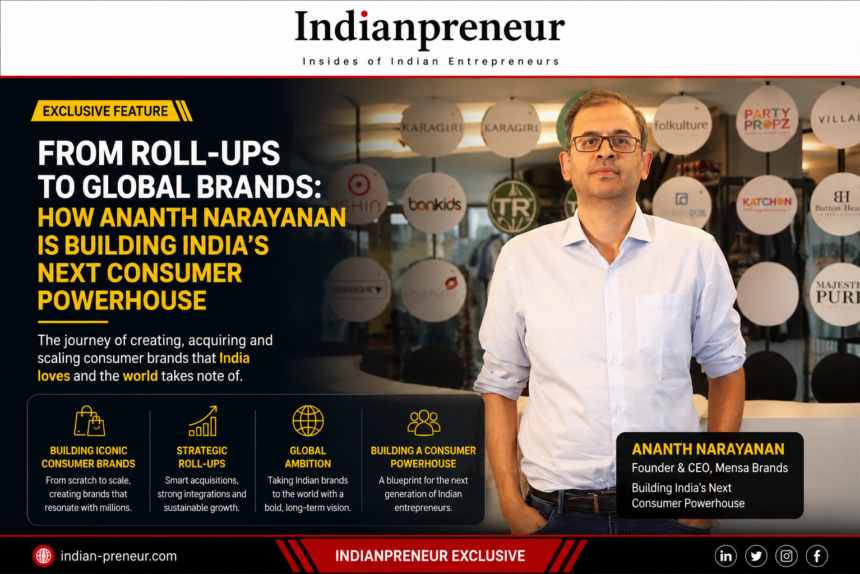
India’s consumer market is witnessing a major transformation, and one entrepreneur is leading a unique strategy to create the country’s next big business empire. Ananth Narayanan, the founder of Mensa Brands, is betting on a roll-up model that acquires promising digital-first brands and helps them scale into global names.
Instead of building a brand from scratch, Narayanan believes India’s future lies in identifying successful homegrown businesses, strengthening their operations, expanding their reach, and taking them to international markets. This approach has positioned Mensa Brands as one of India’s most talked-about startup success stories.
What Is the Roll-Up Strategy?
A roll-up strategy involves acquiring multiple businesses operating in similar or complementary sectors and bringing them under one organization. Rather than competing with these brands, Mensa Brands partners with founders, invests in growth, improves technology, strengthens supply chains, and expands distribution.
The goal is simple: transform small but promising consumer brands into large, profitable businesses that can compete globally.
Unlike traditional acquisitions where companies often lose their identity, Mensa allows brands to maintain their unique personality while providing the resources needed for rapid expansion.
Why Ananth Narayanan Believes This Model Works
Before launching Mensa Brands, Ananth Narayanan held leadership roles at several major companies, including Myntra and Medlife. His experience in fashion, e-commerce, and consumer behavior gave him deep insights into how modern brands grow.
He realized that many Indian founders successfully build products but struggle to scale because of challenges such as:
- 📌 Limited capital
- 📌 Weak supply chain capabilities
- 📌 Rising marketing costs
- 📌 Lack of international expansion opportunities
- 📌 Operational inefficiencies
Instead of letting these businesses plateau, Mensa acquires majority stakes and helps unlock their full potential.
Building Mensa Brands Into a Consumer Giant
Since its launch, Mensa Brands has acquired multiple digital-first brands across categories such as fashion, beauty, home décor, accessories, and lifestyle.
The company focuses on businesses that already have loyal customers and consistent revenue rather than early-stage startups with uncertain business models.
After acquisition, Mensa works on several growth areas:
- ✅ Improving product quality
- ✅ Expanding online and offline sales
- ✅ Strengthening inventory management
- ✅ Increasing profitability
- ✅ Entering new international markets
- ✅ Using technology to improve customer experience
This structured approach allows acquired brands to grow much faster than they could independently.
India’s Consumer Market Is Ready
India’s growing middle class, increasing disposable income, and rapid digital adoption have created one of the world’s fastest-growing consumer markets.
Millions of shoppers now purchase fashion, beauty, electronics, and lifestyle products online every day. At the same time, consumers are increasingly choosing Indian brands over international alternatives.
This shift has created a huge opportunity for companies like Mensa Brands, which can identify successful businesses early and help them scale nationwide and globally.
With India’s e-commerce sector continuing to expand, roll-up companies may play an increasingly important role in building globally recognized consumer businesses.
Beyond Acquisitions: Creating Long-Term Value
For Ananth Narayanan, acquisitions are only the starting point.
The larger objective is to build sustainable brands that generate long-term customer loyalty rather than relying only on aggressive discounts or marketing campaigns.
Mensa emphasizes:
- 📈 Better product innovation
- 📈 Strong customer retention
- 📈 Efficient operations
- 📈 Brand storytelling
- 📈 Data-driven decision making
- 📈 Global market expansion
This balanced strategy focuses on profitability alongside growth, which has become increasingly important as investors prioritize sustainable businesses.
Challenges Ahead
While the roll-up strategy offers significant advantages, it is not without risks.
Managing multiple acquired businesses requires strong operational discipline. Every brand has its own culture, customer base, and market positioning.
Some of the biggest challenges include:
- ⚠️ Integrating different businesses
- ⚠️ Maintaining brand identity
- ⚠️ Controlling operational costs
- ⚠️ Managing inventory efficiently
- ⚠️ Responding to changing consumer preferences
- ⚠️ Growing profitably during competitive market conditions
Successfully handling these challenges will determine whether Mensa can continue expanding at scale.
Can India Build Global Consumer Brands?
Countries like the United States and China have produced globally recognized consumer companies over decades. India now has the talent, manufacturing capabilities, digital infrastructure, and entrepreneurial ecosystem to follow a similar path.
Companies like Mensa Brands are attempting to accelerate this process by giving promising Indian brands access to capital, technology, operational expertise, and international distribution.
Instead of waiting years for individual businesses to scale independently, the roll-up model aims to create stronger consumer companies much faster.
If successful, this approach could reshape India’s consumer landscape and produce several globally competitive brands over the coming years.
The Road Ahead
As India’s startup ecosystem continues to mature, consolidation is expected to become an increasingly common strategy. Rather than building every business independently, entrepreneurs and investors are recognizing the value of combining strong brands under experienced leadership.
With Ananth Narayanan at the helm, Mensa Brands is positioning itself as a long-term consumer powerhouse focused on scaling Indian businesses beyond domestic borders.
Whether this ambitious vision creates India’s next generation of global consumer giants remains to be seen, but the company’s journey is already redefining how brand-building works in the country’s rapidly evolving digital economy.