


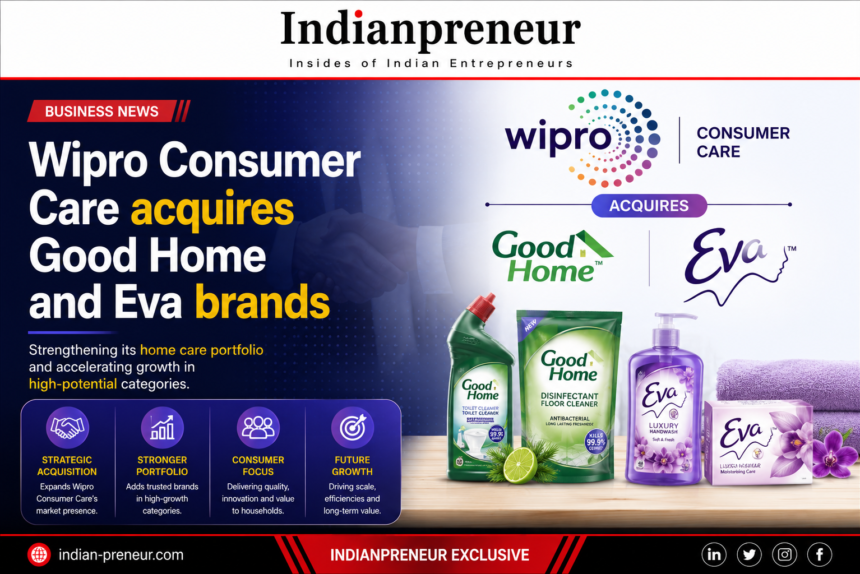
Namaste, fellow readers! The Indian fast-moving consumer goods (FMCG) sector is witnessing massive corporate actions yet again. In a major strategic move, Wipro Consumer Care & Lighting has officially signed definitive agreements to acquire popular household and personal care brands Good Home and Eva from TTK Healthcare Ltd.
Valued at ₹256 crore, this high-profile transaction marks the 17th acquisition for Wipro Consumer Care as it aggressively expands its footprint across domestic and international markets. Let us dive deep into what this multi-crore deal means for the Indian consumer market, retail shelves, and the future of these legacy brands.
Understanding the ₹256 Crore Deal
The corporate landscape in India is heavily driven by consolidation, and legacy companies are constantly looking to strengthen their core portfolios. Under the terms of the agreement, Wipro Consumer Care will take complete charge of both Good Home and Eva.
-
Combined Financial Weight: Together, both brands recorded a robust revenue of ₹148 crore in the financial year FY26.
-
Transaction Value: The final cash consideration stands at ₹256 crore, plus applicable GST.
-
Expected Closure: Industry regulatory filings indicate that the transaction is expected to officially close by September 30, 2026, subject to customary closing conditions.
For TTK Healthcare, this divestment allows the company to streamline its focus toward core segments like pharmaceuticals, medical devices, and other remaining consumer goods like Skore and Woodward’s Gripe Water. Meanwhile, Wipro Enterprises gets an immediate and powerful boost to its fast-growing lifestyle segment.
What the Acquisition Brings to Wipro’s Portfolio
Every major acquisition tells a unique story of market expansion. For Wipro, acquiring these names provides immediate access to well-established consumer trust.
1. Good Home: Strengthening the Home Care Segment
Introduced back in 2007 under TTK Healthcare, Good Home has carved out a stable market space in the Indian household cleaning segment.
-
Its product portfolio features everyday essential items including air care solutions, modern odour removers, heavy-duty scrubbers, and efficient drain cleaners.
-
With rising hygiene awareness and urbanization across Indian households, home care has emerged as a high-margin growth engine.
2. Eva: Capturing the Fragrance and Deodorant Market
Launched way back in 1998, Eva stands tall as one of India’s earliest and most recognizable teen grooming and deodorant brands.
-
The brand offers youth-centric products like deodorant body sprays, skin-friendly no-gas perfumes, underarm roll-ons, and talcum powders.
-
It serves as a perfect companion to Wipro’s existing fragrance franchise, Yardley, allowing the company to effectively capture younger demographic segments.
Leadership Perspectives on the Big Move
Top executives from both corporate entities have expressed immense optimism regarding the transition.
Kumar Chander, Chief Executive Officer of Wipro Consumer Care & Lighting and Managing Director of Wipro Enterprises, noted that the acquisition aligns seamlessly with their long-term vision. He emphasized that both names carry strong consumer relevance and that Wipro plans to invest heavily in product innovation and wider market reach.
Neeraj Khatri, Chief Executive of Wipro Consumer Care, added that the synergy between existing lines and the newly welcomed brands will improve everyday consumer service. On the other side, T.T. Raghunathan, Executive Chairman of TTK Healthcare Ltd, expressed absolute confidence that Wipro’s proven FMCG capabilities will successfully scale the brands to greater heights.
The Road Ahead for Consumers and Retail
So, what changes for regular shoppers walking into local supermarkets or browsing quick-commerce platforms?
Leadership has clarified that both Good Home and Eva will retain their original, trusted brand identities. Instead of a complete rebrand, Wipro Consumer Care plans to utilize its massive distribution network, robust research and development (R&D) facilities, and modern trade muscle to push these products deeper into tier-2 and tier-3 Indian cities.
As competition heats up in India’s dynamic retail space, this strategic move proves that inorganic growth and thoughtful acquisitions remain the ultimate game plan for industry giants looking to capture the next wave of consumer aspirations.