


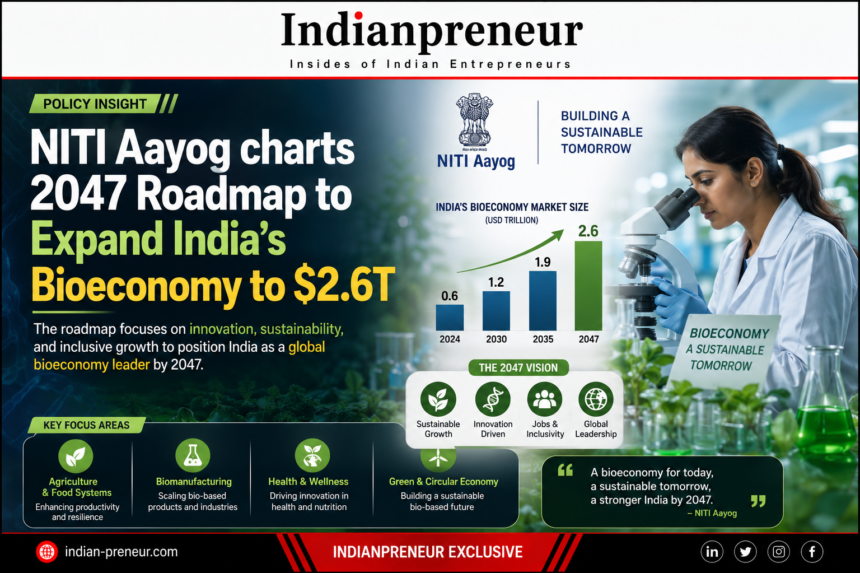
India is preparing for a major transformation in its biotechnology sector as NITI Aayog charts 2047 roadmap to expand India’s Bioeconomy to $2.6T sets an ambitious vision for the country’s future. The government believes biotechnology can become one of the strongest pillars of India’s economic growth over the next two decades, helping the nation emerge as a global innovation leader by 2047.
The roadmap aligns with the vision of Viksit Bharat and aims to significantly increase the contribution of biotechnology across healthcare, agriculture, energy, manufacturing, and environmental sustainability. With rapid advancements in research, innovation, and startup ecosystems, India’s bioeconomy is expected to witness unprecedented growth.
NITI Aayog unveils long-term vision
The newly proposed roadmap outlines a strategy to expand India’s bioeconomy from its current size to nearly $2.6 trillion by 2047. The initiative focuses on creating a globally competitive biotechnology ecosystem supported by strong policy reforms, scientific research, skilled talent, and private-sector participation.
The vision recognizes biotechnology as a strategic sector capable of addressing national challenges while generating employment, boosting exports, and improving public health. It also encourages stronger collaboration between academia, industry, startups, and government institutions.
Why India’s bioeconomy matters
The bioeconomy includes industries that use biological resources, biotechnology, and life sciences to develop products and services. It covers several sectors such as:
● Healthcare and pharmaceuticals
● Agriculture and food technology
● Industrial biotechnology
● Bio-based manufacturing
● Renewable energy and biofuels
● Environmental biotechnology
As global demand for sustainable solutions increases, India has an opportunity to become a leading supplier of biotechnology products and services.
Key focus areas of the roadmap
According to the roadmap, several priority areas will drive the country’s biotechnology growth over the next two decades.
Healthcare innovation
India plans to strengthen research in vaccines, diagnostics, precision medicine, genomics, and advanced therapeutics. The country has already demonstrated its biotechnology capabilities during the COVID-19 pandemic and now aims to build on that success.
Agricultural biotechnology
Improving crop productivity, developing climate-resilient seeds, reducing food losses, and supporting sustainable farming remain major priorities. Biotechnology is expected to help farmers increase productivity while addressing climate-related challenges.
Bio-manufacturing
The roadmap promotes bio-based manufacturing processes that reduce dependence on fossil fuels and chemical-intensive production methods. Industries are expected to adopt cleaner technologies that improve efficiency while lowering carbon emissions.
Sustainable energy
Biofuels, bio-based chemicals, and waste-to-energy technologies will play an important role in India’s transition toward cleaner energy sources. These innovations can reduce dependence on imported fossil fuels while supporting environmental goals.
Strengthening research and innovation
One of the biggest objectives of [NITI Aayog charts 2047 roadmap to expand India’s Bioeconomy to $2.6T] is to encourage innovation across research institutions and startups.
India has witnessed significant growth in biotechnology startups over the last decade. The government now aims to create an environment where scientific discoveries can quickly move from laboratories to commercial markets.
The roadmap also highlights the need for:
● Better funding for research
● Stronger industry-academia collaboration
● Faster technology commercialization
● Improved intellectual property support
● World-class biotechnology infrastructure
These measures are expected to help Indian companies compete globally.
Boosting biotechnology startups
India’s startup ecosystem has become one of the strongest in the world, and biotechnology startups are emerging as a major contributor to innovation.
The roadmap encourages increased investments in deep-tech startups working on healthcare, synthetic biology, genomics, bioinformatics, diagnostics, and sustainable manufacturing.
Access to funding, incubation support, skilled professionals, and global partnerships will help startups scale their innovations more efficiently.
Creating skilled talent
A rapidly growing biotechnology industry will require a highly skilled workforce. The roadmap proposes expanding biotechnology education, vocational training, and advanced research opportunities across universities and research institutes.
Developing talent in artificial intelligence, data science, genomics, molecular biology, and bioengineering will strengthen India’s competitiveness in emerging technologies.
Global partnerships and investments
The roadmap also emphasizes stronger international collaborations with research organizations, universities, multinational companies, and innovation ecosystems.
Global partnerships can accelerate technology transfer, research collaborations, investment inflows, and export opportunities for Indian biotechnology companies.
As countries increasingly invest in biotechnology for healthcare and sustainability, India hopes to position itself as a preferred global partner.
Economic impact by 2047
The ambitious target of reaching a $2.6 trillion bioeconomy could generate millions of high-quality jobs while increasing exports and attracting large-scale investments.
The biotechnology sector has the potential to contribute significantly to India’s GDP by supporting innovation-driven industries rather than traditional manufacturing alone.
Experts believe biotechnology can become one of the country’s fastest-growing sectors over the next two decades if supported by consistent policies and public-private collaboration.
Road ahead
The announcement of [NITI Aayog charts 2047 roadmap to expand India’s Bioeconomy to $2.6T] signals India’s intent to become a global biotechnology powerhouse. While achieving such an ambitious target will require sustained investment, regulatory support, and continuous innovation, the roadmap provides a clear direction for long-term growth.
If successfully implemented, the strategy could transform healthcare, agriculture, manufacturing, clean energy, and scientific research while creating new opportunities for businesses, startups, researchers, and skilled professionals. As India moves toward its 2047 vision, biotechnology is expected to play a defining role in building a more sustainable, innovative, and globally competitive economy.