


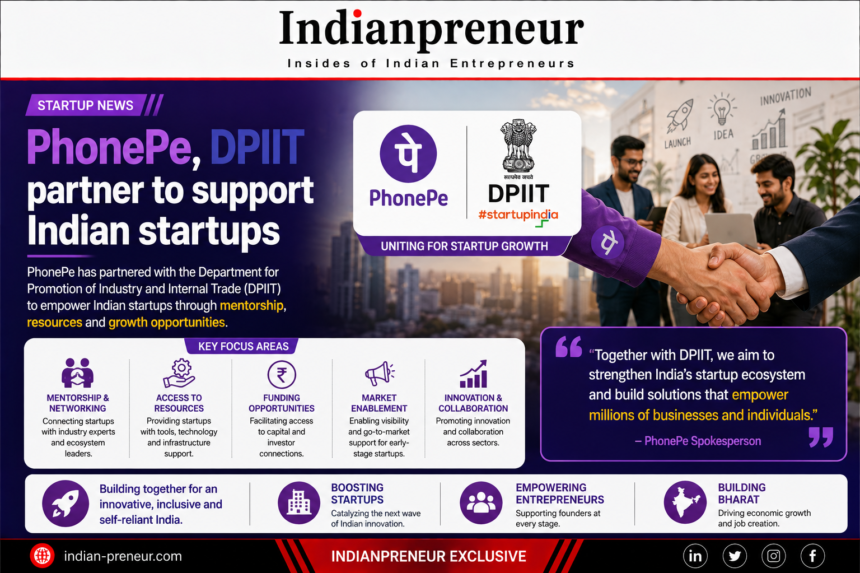
The Department for Promotion of Industry and Internal Trade (DPIIT) has partnered with PhonePe to provide additional support to India’s growing startup ecosystem. The collaboration, formalised through a Memorandum of Understanding (MoU) signed on August 19, aims to help DPIIT-recognised startups access digital payment infrastructure, technology and market opportunities.
The partnership comes as the government continues to bring private-sector companies into the Startup India ecosystem. For young businesses, access to reliable technology, customers, digital platforms and industry networks can play an important role in moving from the early stage to sustainable growth.
PhonePe to offer payment and technology support
Under the new arrangement, PhonePe will provide recognised startups with transaction credits through its Payment Gateway. This can help eligible businesses manage some of the costs associated with accepting digital payments as they build and scale their online operations.
The partnership will also provide startups with access to the Indus AppStore, PhonePe’s made-for-India app marketplace. For consumer-facing startups, visibility across additional digital channels could help them reach more users and strengthen their distribution strategy.
The support will include:
- ● Transaction credits through PhonePe Payment Gateway
- ● Access to Indus AppStore
- ● Dedicated onboarding and support
- ● Opportunities for greater brand visibility
- ● Access to technology and digital infrastructure
These measures are aimed at reducing some of the operational challenges faced by startups while giving founders more opportunities to focus on product development, customer acquisition and business expansion.
DPIIT expands industry support for startups
The DPIIT partnership with PhonePe is part of a broader government effort to connect startups with established companies and industry ecosystems.
DPIIT has increasingly used partnerships with private organisations to provide startups with practical support beyond government schemes. Its Startup India programme includes initiatives around funding, mentorship, market access, intellectual property and ecosystem development.
The government has also signed several other startup-focused agreements with industry players in recent months. These collaborations have covered areas including digital payments, cloud infrastructure, mobility, artificial intelligence, investment and global market access.
For founders, such partnerships can be valuable because startups often need more than capital during their early years. Access to technology, distribution channels, experienced mentors and established customer networks can influence how quickly a business can scale.
Why the PhonePe partnership matters
India has one of the world’s largest startup ecosystems, with thousands of recognised businesses operating across sectors ranging from fintech and e-commerce to healthcare, education, manufacturing and emerging technologies.
For many early-stage companies, digital payments are a basic part of their business infrastructure. A startup selling products online, running a subscription service or offering digital services needs payment systems that can handle transactions efficiently and securely.
By offering PhonePe Payment Gateway support, the partnership could make it easier for eligible startups to access established payment infrastructure while they develop their businesses.
At the same time, access to the Indus AppStore could provide another distribution avenue for startups developing mobile applications. This becomes particularly relevant as Indian businesses increasingly look for platforms designed around the country’s diverse digital consumer base.
Focus on helping startups scale
The broader objective of the collaboration is to help Indian startups move beyond the initial stages of development and build sustainable businesses.
Startups frequently face challenges related to customer acquisition, technology costs, payments and visibility. Industry partnerships can address some of these gaps by allowing founders to use established platforms and infrastructure instead of building every capability from scratch.
The collaboration also reflects a growing focus on creating stronger links between government programmes and private-sector technology companies.
For DPIIT-recognised startups, these partnerships can create additional opportunities to access resources that may otherwise be expensive or difficult to obtain during the early stages of business.
Part of a wider Startup India ecosystem
The latest agreement adds to the growing network of corporate partnerships supporting the Startup India initiative.
DPIIT has previously partnered with companies across sectors to provide startups with mentorship, technology infrastructure, funding opportunities and market access. In September 2025, for example, Startup India and CarDekho Group signed an MoU aimed at supporting startups in mobility, fintech, insurtech and emerging technologies.
The government has also been expanding opportunities for recognised startups to reach international markets. In August 2026, the Directorate General of Foreign Trade expanded its “Source from India” platform to eligible DPIIT-recognised startups, giving them greater visibility among overseas buyers.
Together, such initiatives indicate a broader strategy: provide startups with access to funding, technology, customers, mentors and markets so that promising businesses can scale more effectively.
What it means for Indian founders
The PhonePe-DPIIT partnership is likely to be particularly relevant for startups that depend heavily on digital payments and mobile distribution.
Instead of relying only on traditional government support, founders can potentially benefit from a combination of public programmes and private-sector infrastructure. This can help reduce barriers during the early growth phase and give startups more room to experiment, acquire customers and improve their products.
As India’s startup ecosystem continues to mature, partnerships between government agencies and technology companies could become an increasingly important part of the country’s innovation strategy.
The latest agreement between PhonePe and DPIIT therefore represents more than a payment-related collaboration. It is part of a wider push to build an environment where Indian startups can access the infrastructure, technology and market opportunities needed to grow from small ventures into scalable businesses.