

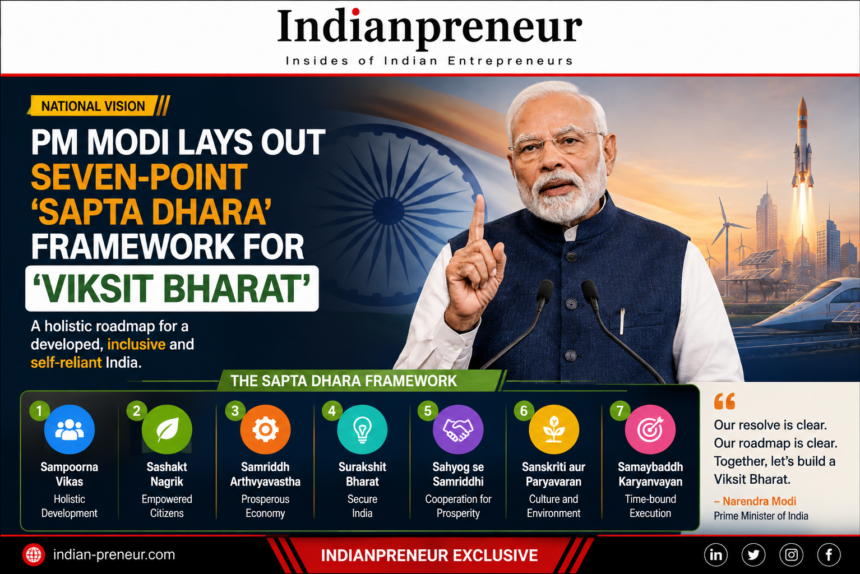
Prime Minister Narendra Modi has outlined a seven-point development framework called ‘Sapta Dhara’ to accelerate India’s journey towards becoming a developed nation, or ‘Viksit Bharat’, by 2047. The roadmap was presented during his Independence Day address from the Red Fort on August 15, 2026, with a focus on strengthening India’s economic, technological, strategic and cultural capabilities.
The Sapta Dhara framework brings together seven major streams of national strength. These include manufacturing, agriculture and food processing, technology and innovation, Gati Shakti, defence, the green and blue economy, and India’s soft power.
What is the ‘Sapta Dhara’ framework?
The term Sapta Dhara refers to seven streams of strength that Prime Minister Modi believes can provide fresh momentum to India’s development journey. Drawing a parallel with the ancient reference to ‘Sapta Sindhu’, Modi said India now needs new streams of strength to build a developed nation.
The Prime Minister said the combined strength of these seven areas could help India achieve in the next five to seven years what could not be achieved over several decades.
The seven focus areas are:
- Manufacturing Power
- Agriculture and Food Processing
- Technology and Innovation
- Gati Shakti
- Defence Power
- Green and Blue Economy
- India’s Soft Power
1. Manufacturing Power
Manufacturing has been placed at the heart of the Sapta Dhara vision. Modi called for India to develop complete value chains, covering everything from components and design to finished products.
The aim is to make India a trusted global supply-chain partner while improving competitiveness on cost, quality and scale. The Prime Minister also stressed that Indian products must meet international standards and that there should be no compromise on quality.
For manufacturers, entrepreneurs and MSMEs, the message is clear: Indian products must increasingly compete in global markets on both quality and reliability.
2. Agriculture and Food Processing
The second stream focuses on taking Indian agriculture from the farm to international markets. Modi said India’s farmers should benefit from growing access to global markets and called for stronger farm-to-export supply chains.
Traditional Indian foods, millets, spices, fruits, flowers and chemical-free agricultural products, he said, have the potential to become global brands if they meet international standards.
This approach could also create opportunities for food processing, packaging, logistics and exports while helping farmers gain access to larger markets.
3. Technology and Innovation
Technology is another major pillar of the Viksit Bharat roadmap. Modi highlighted emerging fields such as artificial intelligence, quantum technology, space, robotics and data centres as areas where India can build global leadership.
He also pointed to India’s achievements in UPI and digital public infrastructure, arguing that Indian digital technologies should reach markets around the world.
The Prime Minister further set an ambition for India to lead in next-generation communication technologies, including Made-in-India 6G.
4. Gati Shakti
The fourth stream is Gati Shakti, centred on faster and more seamless connectivity.
The vision includes high-speed rail, modern highways, airports, inland waterways and multimodal logistics. Modi also highlighted the importance of port-led development, saying ports should evolve beyond being places for loading and unloading goods and instead become engines of economic growth.
Better connectivity is expected to support businesses, reduce logistics challenges and improve the movement of people and goods across the country.
5. Defence Power
The fifth stream focuses on defence self-reliance and India’s emergence as a global supplier of advanced defence technologies.
Modi called for greater capabilities in areas such as drones, counter-drone systems, cyber security and hypersonic defence technologies. The broader objective is to reduce dependence on imports while developing technologies that can also be supplied to international markets.
This makes defence indigenisation an important part of India’s long-term strategic and industrial ambitions.
6. Green and Blue Economy
The sixth stream combines India’s green and blue economic potential.
On the green side, the focus includes renewable energy, green hydrogen, energy storage, green mobility and sustainable manufacturing. India also wants to develop solutions that can contribute to global efforts to address environmental challenges.
The blue economy covers opportunities linked to India’s coastline and oceans, including fisheries, coastal tourism and ocean technology. Together, these areas are expected to support sustainable economic growth.
7. India’s Soft Power
The seventh stream looks beyond traditional economic and strategic strength and focuses on India’s global cultural influence.
Modi highlighted India’s strengths in yoga, Ayurveda, spiritual and cultural traditions, handicrafts, films, animation, visual effects, gaming and digital content.
The India soft power agenda seeks to turn these strengths into globally recognised sectors while expanding India’s cultural influence and creating new economic opportunities.
Sapta Dhara aims for a holistic approach
A key feature of the Sapta Dhara framework is that the seven streams are not intended to operate independently. Modi described them as interconnected sources of national strength that need to work together.
For example, stronger manufacturing can support exports, better infrastructure can reduce logistics costs, technology can improve agriculture and defence capabilities, while green technologies can create new industries.
The government has therefore positioned Sapta Dhara as a broad development framework rather than a single-sector policy announcement.
What it means for India’s Viksit Bharat goal
The framework gives a clear indication of the areas expected to receive greater attention as India works towards its Viksit Bharat 2047 ambition.
The emphasis on manufacturing and exports could support job creation, while technology and innovation could strengthen India’s position in emerging industries. At the same time, investments in infrastructure, defence and sustainable development could improve the country’s long-term economic resilience.
The success of the Sapta Dhara roadmap, however, will depend on how effectively its broad priorities are translated into policies, investments and implementation across states and industries.
For now, the seven-point framework provides a new strategic direction for India’s development journey, with the government aiming to combine economic growth, technological progress, national security, sustainability and global influence to build a Viksit Bharat by 2047.