

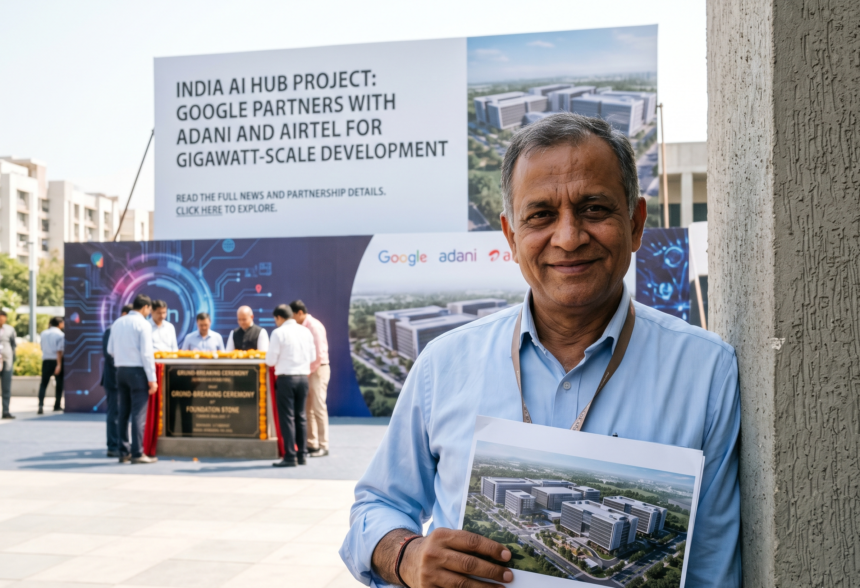
India is on the brink of a digital revolution, with tech behemoth Google recently launching construction on its mammoth India AI Hub in Visakhapatnam. The billion-dollar project, estimated to be worth around $15 billion (Rs 1.26 lakh crore), is a joint venture between Google and the Adani Group and Bharti Airtel. This hub, which seeks to establish India as a top player in the field of artificial intelligence, is expected to be the nerve center of the nation’s “Viksit Bharat” agenda.
The India AI Hub is more than a data center; it is a gigawatt-scale infrastructure that will support some of the world’s most advanced AI applications. Google‘s partnership with Adani ConneX and Nxtra by Airtel means it can tap into regional know-how in infrastructure and connectivity to create a digital corridor of the future.
A Powerhouse Partnership for Infrastructure
This partnership involves the expertise of three key players in the making of the India AI Hub. Google is contributing to the state-of-the-art AI stack and software solutions while the infrastructure is being built by Indian giants.
-
Adani ConneX: This joint venture is spearheading the building of large data centers. Their priority is building sustainable, carbon-neutral data centers fed by renewable energy.
-
Airtel (Nxtra): Airtel, through its data center division, Nxtra, is providing connectivity. They are connecting the hub with an all-India fiber network and a next-gen cable landing station in Vizag.
-
Google Cloud: The company is bringing its cutting-edge AI processors, generative AI technologies and tools to power businesses in India and the rest of the world.
Why Visakhapatnam?
The “City of Destiny” – Visakhapatnam – has become a hub for the India AI Hub. This was mainly due to its coastal location, which is ideal for landing international submarine cables. These cables are critical for providing fast, low-latency internet, which is necessary for real-time AI applications.
And the government of Andhra Pradesh has been crucial in providing incentives. The 601 acre project is spread across sites such as Tarluvada and Rambilli. The state has also agreed to supply cheap green electricity and provide water for the server farms to keep them cool for the India AI Hub to be viable.
Key Features of the India AI Hub
The initiative is not just about computers and cables; it’s a blueprint for digital development. Here are just some of the highlights of the Google–Adani–Airtel project:
-
Gigawatt-Scale Compute: The data center hub will be one of Asia’s largest with its goal of reaching 1 GW of compute capacity.
-
Sustainability: Commitment to green energy, with the Adani Group incorporating renewable energy to operate the data centers.
-
Global Connectivity: It will be connected to the “America-India Connect” project, which includes three new subsea cables landing in Vizag.
-
Employment Generation: The project will generate thousands of high-tech jobs in IT, construction and sustainable energy.
Boosting the “Viksit Bharat” Vision
At the event, Union IT Minister Ashwini Vaishnaw noted the India AI Hub is aligned with India’s vision of becoming a $5 trillion economy. With Google‘s cutting-edge technology now available in India, Indian startups and academics will not need to depend on foreign data centres. They will be able to develop and scale AI solutions in India.
The collaboration with Adani and Airtel also means that AI technology benefits the masses. Google is also launching its STAR (Skills Trade and Readiness) program. This will equip local young people with digital and financial skills, so the India AI Hub delivers a future-ready workforce.
Impact on Indian Businesses and Startups
For Indian businesses, the India AI Hub translates to quicker access to AI services. For example, a small retailer using AI for inventory management or a large healthcare company working with patient data, the proximity of the data centers will help cut costs and speed up operations.
The partnership between Google, Adani and Airtel marks the dawn of “Sovereign AI” in India. In doing so, by keeping data within India, it resolves issues around data sovereignty, security and privacy, as well as promotes local innovation.
Conclusion
India AI Hub is a case study in the success of international technology meeting industrial might. Thanks to Google, Adani and Airtel, Visakhapatnam is on its way to becoming the AI hub of India. As work moves ahead towards a 2028 deadline, the world will look on as this $15 billion investment in the digital soul of a nation is realised.