


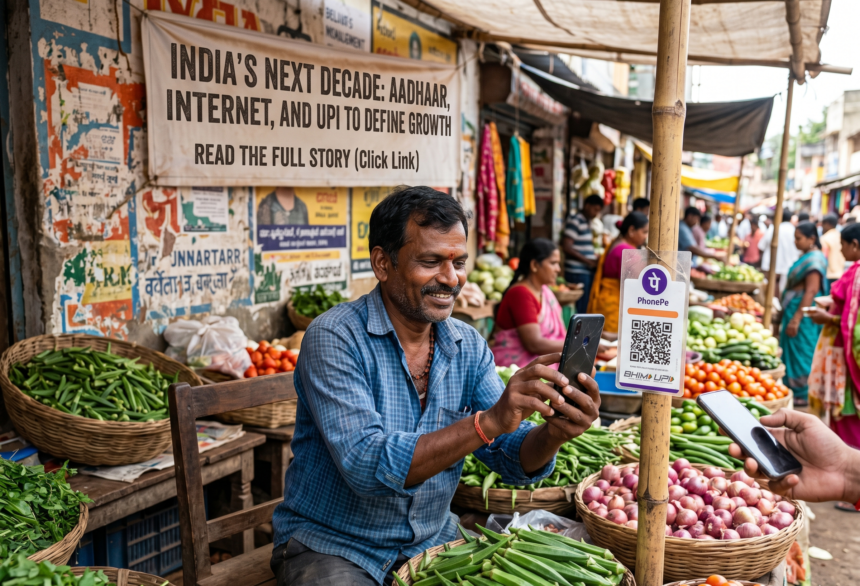
India’s economic stage is witnessing a profound transformation, and business moguls have already mapped out the next decade. Rahul Chari, the Co-founder and CTO of digital payment solutions provider, PhonePe, pointed to a magic trio that will shape the country’s future at a recent industry event. He claimed that the India’s Next Decade to be defined by Aadhaar, Internet, and UPI, giving the country a digital-first economy which is the envy of the world.
For a nation that was “cash-only”, the digital revolution has been magical. It’s not just a matter of efficiency, however; it’s a matter of democratisation.
The Foundation: Aadhaar as the Digital Identity
Aadhaar is at the centre of this transformation. Prior to its introduction, the lack of a formal identity meant many in India couldn’t access financial and government services.
Rahul Chari identified Aadhaar as the “identity layer” for a digital economy. With a unique identity, biometrically linked to more than 1 billion people, India solved the trust and verification problem. It is now used for a range of services such as opening bank accounts and receiving direct benefit payments.
-
Identity at Scale: Simpler KYC (Know Your Customer) procedures.
-
Financial Inclusion: Banking the unbanked.
-
Security: Mitigating fraud with biometric identification.
The Catalyst: Higher Speed Internet Penetration
Identity was the key, the Internet was the roadmap. Thanks to cheap data and the widespread use of mobile phones, we now take the Internet for granted.
Chari recalled that the remarkable reach of the Internet in rural India is the key. It has connected the rural and urban areas, enabling a village merchant to access the same banking services as a company in Mumbai. In India’s Next Decade to be defined by Aadhaar, Internet, and UPI — the speed and quality of the Internet will be a major deciding factor for the adoption of AI and sophisticated cloud computing.
The Engine: UPI and Payment revolution
If Aadhaar is the name, the Internet is the road and UPI (Unified Payments Interface) is the engine. UPI has revolutionised the way we make payments since its introduction. He has made bank transfers frictionless and cash payments unsafe.
As a pioneer in the fintech sector, with PhonePe, Rahul Chari highlighted that UPI is not just a payment system, it is a protocol. The multi-banking feature of UPI enables different apps and banks to communicate with one another, thereby enabling a “frictionless” user experience.
Why UPI is Winning:
-
Zero Cost: Very low or no fees to the user.
-
Real-time: Instant settlement 24/7.
-
Simplicity: Pay by QR code, and even at a tea shop.
The Synergy: How They Work Together
It’s the intersection of the three that matters. Aadhaar authenticated identity linked to fast Internet combined with a strong payments layer such as UPI form a “Digital Public Infrastructure” (DPI).
Rahul Chari says that in India’s Next Decade to be defined by Aadhaar, Internet, and UPI, this infrastructure will extend beyond payments. We are talking about the next decade of digitizing credit, insurance and healthcare. For example, the “Open Network for Digital Commerce” (ONDC) and “Account Aggregator” are the next level of advancement on this platform.
What’s next in the next decade?
Looking ahead the emphasis will be on “access” to “sophistication”. The Indian market will see a number of trends emerge:
-
Hyper-Localization: Language-focused, Internet-based services.
-
Lending at the Point of Sale: Instant loans to vendor shops trained in UPI with digital footprints as collateral.
-
Global Expansion: India’s digital technologies such as UPI being picked up by other countries.
-
AI Integration: Leveraging all the data from the Internet and UPI to give financial advice.
Conclusion: India, Superpower of the Future
Rahul Chari’s point is: the hard work of laying down the foundation is over. Now the next decade will be focused on creating best-in-class products. India’s Next Decade to be defined by Aadhaar, Internet, and UPI to be the defining theme for India’s Next Decade is a shift from consuming to contribute to the global technology.
For the average citizen, this translates to more information, access to more avenues to build wealth and a future where “Digital India” becomes a reality. As the physical and digital world collide, the power of Aadhaar, the ubiquity of the Internet and the finetime of UPI will be the foundation of the Indian narrative.